 EN
EN  ES
ES 
Floating Solar on Reservoir Number 2
By Julia Caulfield
April 2, 2026
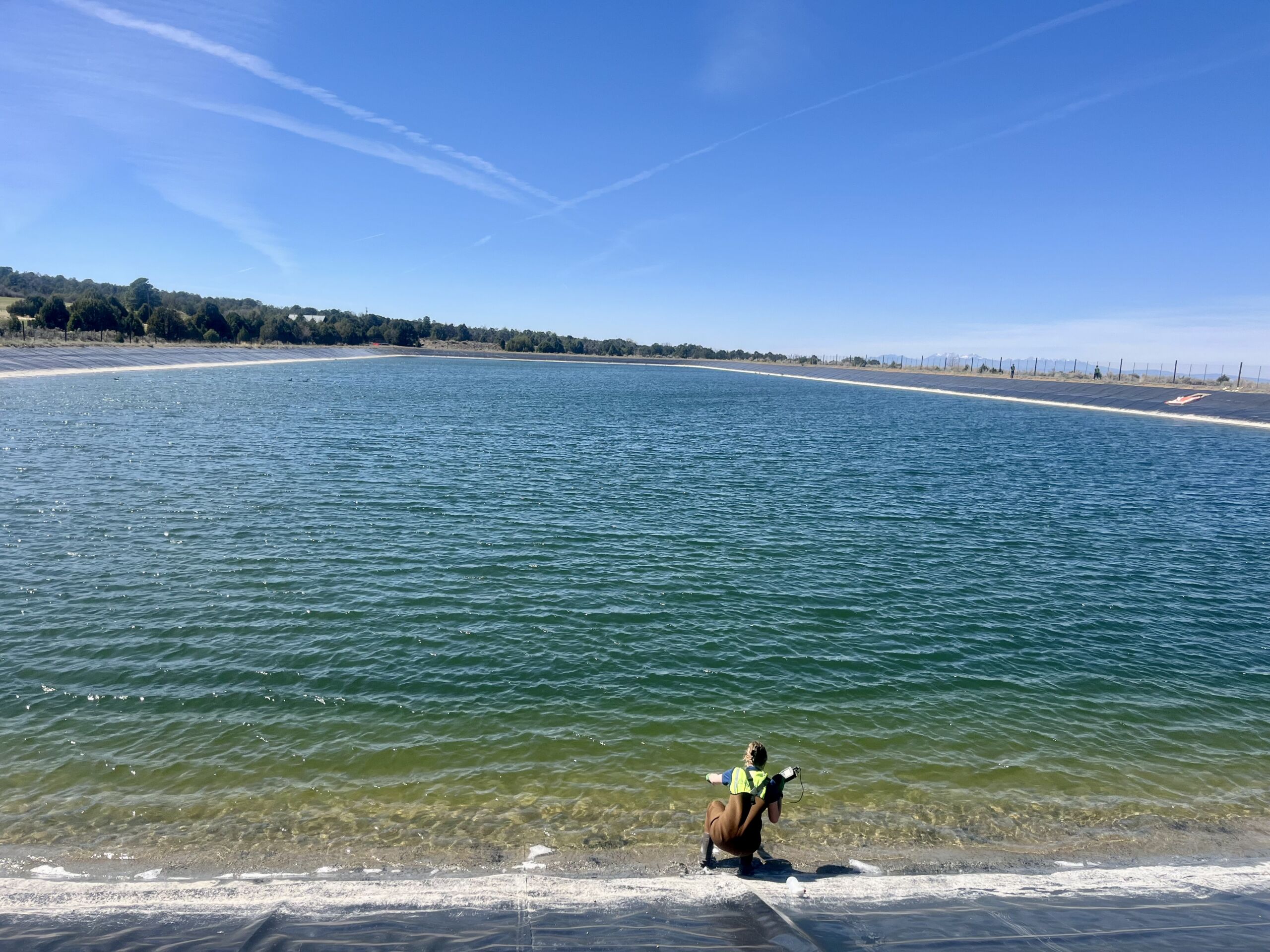
Norwood Water Commission Reservoir (Julia Caulfield/KOTO)
It’s blustery and warm on Wright’s Mesa.
Siobhan Montoya Lavender stands outside the Norwood Water Commission’s Reservoir No. 2.
“Last year, the Norwood Water Commission reached out to EcoAction Partners to say, ‘Hey, we’re having all these evaporation issues. We’re having algae blooms that are expensive to treat. We have really high electric bills. We’ve looked into this very shallowly and we’ve said maybe floating solar is an option. Could you research more and tell us more?’” Lavender said.
Lavender, the climate action development director for EcoAction — a regional climate solutions nonprofit — said it was an immediate yes. She began researching grant opportunities for a feasibility study to determine whether floating solar, or floatovoltaics, would be possible on the reservoir.
There was one problem.
“All the grants that I would normally go after for this dried up,” she said.
EcoAction got creative and reached out to the Colorado School of Mines and its senior capstone program.
That is how seven graduating seniors from Golden ended up in Norwood to conduct the feasibility study under the guidance of their professors.
“They will be doing all these wonderful studies and engineering specifications for us basically pro bono,” Lavender said. “This is something that would normally cost the town $40,000 to $50,000.”
Grace Flanagan, one of the students, is studying environmental engineering.
“It’s basically an experience for us to get hands-on, real-world experience that you wouldn’t get in the classroom,” Flanagan said.
The students dispersed around the reservoir. Some collected measurements of the pond while Flanagan slid down the bank to test the water.
“We’re doing a bit of field measurements and simulations on the computer to see how much electricity we could generate from the solar panels, try and estimate how much reduction in evaporation we could get,” Flanagan said. “Also, we’re taking some baseline water quality data so we can make sure there isn’t going to be leaching, because we know one of the community concerns was metal leaching. So we’re testing for metals. The team over there is doing site analysis to make sure we can model the site to get a good idea of the dimensions and sizing, because each panel gets a float. We also have to design an anchor system so the solar panels won’t move around.”
Walter Sharp, a technical adviser on the project, said there are two primary benefits of the solar panels.
The first is reducing algae blooms on the water.
“It’s blocking the sunlight,” Sharp said. “Algae grows on photosynthesis, which is based on sunlight. So if there’s no sunlight, there’s no growth.”
The second benefit is reducing evaporation from the reservoir.
“The panels are only about two feet off the water,” Sharp said. “Any humidity that occurs is going to keep the water temperature cooler in that region. Evaporation is based on heat and wind, so if you lower the temperature and you lower the wind, you lower the evaporation.”
While the project uses solar panels, the panels themselves are at a low slope and are not ideal for energy production. Lavender said the project is primarily a water conservation effort, with the added benefit of energy generation.
For Sara Ownes, Norwood’s town manager, anything that offsets water loss using proactive measures is a win.
“We’re in a 50-year drought, and we’re going into an even worse drought season this year,” Ownes said. “So as proactive as we can be, from the town side of things, to set ourselves up for safety, to be able to continue to offer water to everybody, as well as be able to mitigate fires, is priority No. 1, quite honestly.”
Back by the water, Flanagan checked measurements. As her senior capstone project, she was drawn to the science, but the work is also personal. Flanagan grew up in a small town in Maryland where the water was contaminated, and her family has relied on bottled water for years.
“It was really cool how I could give back to a community in the sense of making the water better and more treatable for the community,” Flanagan said. “Especially as there’s a lot of water scarcity, it’s nice to see that I could do something to reduce that impact.”
The feasibility study is just the first step toward potentially bringing floatovoltaics to the Norwood reservoir. But it is an important step as the town looks ahead, takes its future into its own hands and continues to adapt to a changing water landscape.

Recent News

Finding the Glorians with Terry Tempest Williams
July 15, 2026
In her new book, The Glorians: Visitations from the Holy Ordinary, author Terry Tempest Williams asks us to find moments of grace in a complicated world. Tempest Williams spoke with KOTO's Julia Caulfield.

Remembering a BF Deal
June 24, 2026
KOTO's founder Jim Bedford (aka BF Deal) passed away on June 20, 2026. A visionary and leader, he is remembered by those who loved him and leaves a legacy in the Telluride community.

Prohaska, Wisor Cleared from Ethics Violation in Mountain Village Investigation
June 3, 2026
An independent investigation into the conversations and actions surrounding an offer to purchase a portion of the Telluride Ski Resort by former Mountain Village Mayor Marti Prohaska and former Telluride Town Councilmember Meehan Fee, with support from former Mountain Village Town Manager Paul Wisor, found that neither Prohaska nor Wisor violated local, state or federal ethics codes in their actions.